Wednesday, 8 July 2020

Differences between APA 6 and APA 7 - Changes in the 7th edition

In terms of mechanics, the seventh edition of the APA Publication Manual contains a variety of minor changes from the sixth edition. There are several essay writing service offers various types of academic tools. if you will search an APA referencing generator tool in search engine which can generate your reference list very fast but before generating references for your paper have a look at this visual guide that can remove your confusion of APA 6 vs APA 7.
Here I am sharing a visual info graph

APA 6 vs APA 7
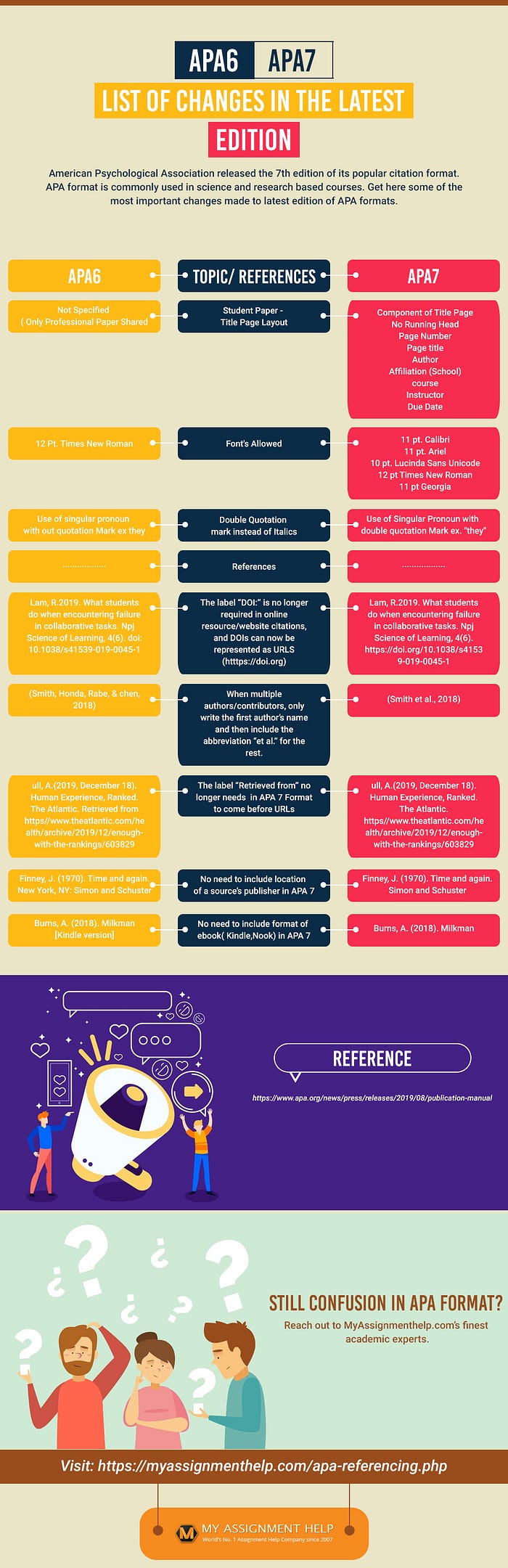

APA 6

In in-text citations regarding sources having three to five authors, all authors must be listed the first time, and then utilises et al., after that, regarding sources having six authors or more, utilise et al. regarding all citations. No direction from manual itself (except the APA Style Blog). Secondary source citation shall not involve the date regarding the original source. Surnames and initials shall be provided for up till seven authors in reference entry. When eight authors or more exist, three spaced ellipsis points should be used after sixth author, and then the final author name (without ampersand). When a publisher as well as author of any work are the same, the word “Author” must be utilized as the name of publisher in the reference entry. The issue number must be included when the journal is paginated distinctly by issue. The location of publisher (city, state, etc.) should be provided prior to publisher name. URLs shall encompass a retrieval phrase (for instance, ‘Retrieved from’)

APA 7


In in-text citations, utilise et al. regarding all citations for the sources having three authors or more. It should be quoted directly from any audiovisual work, including any time stamp designing the commencement of the quoted material in lieu of any page number. Secondary source citation shall encompass the date concerning the original source. Initials and surnames shall be provided for up to twenty authors in reference entry. When twenty one authors or more exist, the ellipsis shall be utilised after the nineteenth, and then the name of final author (without ampersand). When a publisher as well as the author of any work are the same, the publisher should be omitted in the reference entry. The issue number shall be included regarding all periodicals having issue numbers. The location of the publisher (city, state, etc.) shall not be included after publisher name in reference. The terms ‘Accessed from’ or ‘Retrieved from’ are no longer compulsory prior to a URL, except in rare cases where retrieval date is compulsory.

Monday, 6 July 2020

Is it a Good Idea to Pay Someone to Do My Homework?

Getting Homework Help from Experts, There are some mixed views. let explore the good or bad thing here.. 
The Good:
· Students shall be able to manage and cope with their stress levels by controlling the quantum of work that they have.
· Homework scores shall increase.
· More number of students shall be able to graduate.
· Students shall have more time regarding more significant homework tasks or social life.
Pay someone to do my homework benefits a particular student in several ways even beyond academics. The students are permitted to focus on several aspects regarding life. The students shall be able to focus on physical health, mental health, hobbies, finances, and also social health. This results in a happier life as well as a happier lifestyle, in connection to a certain homework that the student probably may not remember in two years. It can be seen as harmless, as long as such student balance everything in an appropriate manner and still really study.
The Bad:
· The student peers may perceive this as a prejudicial advantage.
· It may be said that the student considered cheating.
· Students shall barely learn or practice the study materials.
· The work would not be the original thoughts of that student.


The bad regarding making payment for homework would be an extensive list, contingent on to whom the question is asked. It may result in some heavy consequences. If plagiarizing is discovered and caught, then it may result in an absolute zero in the course or much worse than that, preferably expulsion. Although, other than such consequences, if a student does not do the homework, then that student is not learning or practicing. This overthrows the purpose and aim of going to universities in order to study if a specific student is not able to handle the pressure and workload and learn and study in its own way.

Writing a Great Thesis Statement: Dos and Don’ts

A thesis statement is one-two sentences that offer a concise summary of the initial idea of the essay or a research paper. It claims the central idea of the document and acts as a road map. It is challenging as it is of high significance– no wonder why lots of students prefer to use a thesis statement generator for an instant solution.

Clueless About Developing A Thesis Statement For A Research Paper? before writing a strong thesis statement, you must understand the difference between the bad and the good. Let’s take this example:
Bad: Drug consumption is terrible for you.- It is too broad. What are the specific detriments of drug consumption that you would prefer to focus on?
Good: High intakes of a drug have detrimental effects on your health, such as weight loss, stroke, mental confusion, and liver damage. — Notice how we made the reasons more specific. It would help if you didn’t mention all the detriment in your thesis statement, but always point to the fundamental areas you are going to explore.
Here are some Dos and Don’ts of drafting a thesis statement.
Dos:
· Do be specific as much as possible about the main focus of your argument.
· Do explain the broader topic from your essay in the thesis statement.
· Do split your long sentences into two sentences.
· Do write in a firm tone without sounding too bossy or authoritative.
Don’ts:
· Don’t be vague and include unrelated factors and sentence fragments.
· Don’t list out every idea from your body paragraphs unless mentioned in the instructions.
· Don’t announce you are looking to do and write purpose statements like “The goal of this research is to discuss the detriment of drug consumption.”
· Don’t write your thesis statement as a “fact” but as an opinion.
· Don’t generalise to sound neutral. Take a stand and be firm.
· Don’t write your statement as a question or use a quote.
· Don’t over complicate your thesis by squishing in too many ideas.
· Don’t state your opinion as to the first person, such as, “I think”, “I state”, or “I believe.”
· Don’t use offensive or insulting words to demean the readers you are trying to persuade.
Writing without the support of a professional thesis helper won’t be impossible if you consider all these pointers.
Also, you can use a thesis statement generator for generating a few thesis statement samples. Please read them and try to implement the changes in your writing for better scores.

Saturday, 4 July 2020

5 Excellent Tips to Write a Strong Conclusion for Your Thesis

A powerful conclusion is of high significance for the success of your thesis.  Hence, we will give you five solid tips to write an outstanding conclusion for your dissertation. Read them thoroughly and put them to practice if you want to succeed without availing thesis writing service from a professional.
#Tip 1: Don’t just summarise:
As we all know, summarising is a crucial factor in the conclusion. However, don’t just focus on synthesizing the entire document. You must explain to your readers how they should to apply the information. Give your readers something to think about and take a resolution for a change.
#Tip 2: Try not to introduce any new information:
Professional essay writers advise students to avoid introducing a new idea in conclusion. However, if you do for explaining the application of the theory in a broader sense, be careful about not going too in-depth with the explanation.
#Tip 3: Don’t mention the missed points in your conclusion:
A lot of students make the mistake of mentioning the points they missed in the body of the paper. Strictly avoid doing that if you don’t want to confuse your readers. Adding new details, in the end, will not conclude your essay but raise more questions. That’s why a lot of writers from thesis writing services ask students not to choose a broad topic and narrow down the search to create a compact and well-knit paper.
#Tip 4: No unnecessary use of the word “conclusion”:
Avoid using the word “conclusion” in the body of the paper as it might confuse your readers. Some readers may give up reading until the actual conclusion. So, be careful how and when you the word in the body paragraphs.
#Tip 5: Be careful about your tone:
You are certainly allowed to portray your ideologies in your paper, but make sure you don’t go over the top. Avoid using a bossy or authoritative tone; instead, be clear and polite. Focus on the holistic assessment of the subject and avoid writing overly generalised discussions. In doing so, you will miss the primary point of your paper.
And there you go! Understand them and put them to practice. However, if you still want to buy cheap assignment help online for your dissertation, do diligent research and sign up with the best option.

Friday, 3 July 2020

4 crucial steps to present a flawless analytical essay

Imagine you’ve been asked to write an analytical essay by your professor. But after you submit the paper, you notice that your grades haven’t improved at all. This could be because you haven’t quite understood how to present this type of essay.
So, if you need more clarity on presenting an analytical essay, you need to know how each section of the piece is crafted. Listed below are the right ways to prepare the essay that the experts from analytical essay writing help service suggest.
1. Write a compelling introduction
Your introduction should present your reader with background details about your topic. Make sure your introduction is intriguing but not overzealous. It’s imperative to get this step right when you want to get clarity on how to write an analytical essay or need writing help with essay.
Also, try not to make the introductions too dramatic (don’t use question or exclamation at the beginning of this type of paper). In general, avoid using the first or second person in your essay. Mention the thesis statement, generally as the last sentence in the first paragraph of your analytical essay.
2. Write the body paragraphs clearly
Each main paragraph of your analytical essay should have a topic sentence, an analysis, or evidence that backs your analysis and thesis statement.
A topic sentence conveys the reader what the body paragraph will be about. The analysis of the text is where you present your argument. Remember that every claim you make should support your thesis statement.
3. Write a befitting conclusion
This is the section where you remind your reader how you supported your argument. You may also try and establish a broader connection in your conclusion.
This means stating how your argument impacts other claims about your topic, or about how your claim could change the perception of someone reading the analysis that you’ve prepared.
4. Proofread the analytical essay
A paper laced with grammatical errors gets poor grades as opposed to one that has been polished and proofread. Check the spellings, find run-on sentences, and remove the punctuation errors. Always confirm that the spellings are correct if you’re unsure.
Also, use the format for your essay correctly. For instance, using a 12-pt standard font (like Times New Roman or Arial) and 1" margins is standard. While proofreading, find places in the essay that might sound convoluted and simplify them.
Knowing how each of these steps is carried out will help you present the essay perfectly.

Thursday, 2 July 2020

4 usual citation mistakes that students must avoid

Working on citations can be quite overwhelming for students, which is why they resort to tools like MLA or APA citation generator. But, to prepare the citations and referencing pages accurately, it’s vital to steer clear of the common mistakes that many students make.
Whether you’re using the APA or MLA formatting style, these mistakes can take away the credibility of your academic papers and result in poor grades. Here are a few of these mistakes that you need to be careful about.
Not knowing the difference between citations and references
This can be puzzling even for the most accomplished students. And there’s no easy answer for this. Citations are normally included in the body of the paper with direct quotes or something associated with the author or publication that you got the information from. References are generally presented at the end of the paper, state the eminent writers from essay writing service.
Any citation you add in the main body should also be represented by an entry in the reference list. Even if you use the Harvard, MLA or APA citation generator tools, you have to keep these differences in mind.
The curious case of missing punctuation
When you first start writing down the citations, it can be difficult trying to understand why there is to be a period or a comma in certain places. The punctuation may come across irrelevant to you. But when your professors look at your citations, they’ll immediately notice where you have made mistakes in your formatting.
So, it’s always a wise idea to go through a couple of examples of accurate punctuation in citations before you start writing by yourself.
Not maintaining alphabetical order in citations
Citations need to be properly alphabetized. If there are multiple authors for a particular publication, you must arrange them in alphabetical order.
This rule is applicable for both citations as well as the reference list at the bottom of the paper. This way, it’ll be simpler to find the corresponding information.
Not citing the paraphrased sources
If you’re using someone else’s words and rephrasing them in your style, you still need to provide a citation. This is because you’re using information from another individual's work so that detail still needs to be referenced and cited accordingly.
Citing the paraphrased sources can help you avoid accusations of plagiarism. And that’s the last thing you would want to be accused of for any paper you put together.
Ref: http://joshuadollar.mystrikingly.com/blog/4-usual-citation-mistakes-that-students-must-avoid
Keep these mistakes at bay to submit a well-cited paper.

Wednesday, 1 July 2020

A brief glimpse into the vital aspects of ASA referencing style

You may have been asked to follow the ASA(American Society Association) style of citation by your university department. But before you use the ASA referencing generator available online, it’s best to develop some familiarity with this particular citation style.

ASA referencing is similar to the Chicago style of referencing as it follows an author-date system. If you need a better understanding of how to do ASA referencing, read this brief guide.

Reference formatting

If you’re faced with the thought, “How do I do my assignment for me by citing the sources accurately?” check out this referencing format

You must use the title case for every title. Capitalize all words except prepositions (of, in, on, between, through), articles (a, the, and an), and conjunctions (but, and, or). However, you can capitalize on them if they are at the beginning of the title or the subtitle). Even when you use ASA referencing generators, you need to keep this in mind.
Capitalize only the first word in hyphenated compound words, unless the second word is a proper noun or adjective.
All references must follow the alphabetical order by the first authors’ last names.
You must use the first names for all authors, instead of adding initials. But use first and middle-name initials if an author has used initials in the original publication.
You must list all authors. It isn’t acceptable to use et al. in the reference page section unless the work was authored by a committee.
References to social media sources shouldn’t appear in the references page. Instead, it must be footnoted in the body text where referenced. This footnote must include the page's title and URL.

In-text citation

General formatting
Cite the last name of the author and year of publication while adding the in-text citation. Make sure to include page numbers within the citation when quoting the authors’ words directly, paraphrasing a passage, or referring to particular passages.
Using Quotes
Keep the short quotations in the body of the academic paper within quotation marks.
Block quotations (of more than 40 words) must be single-spaced and offset from the main text. Don’t use quotation marks when you’re adding block quotes.
Mention the page number followed by the year of publication after a colon (note that in the in-text citation, there’s no space between the colon and the page number). E.g., As discussed by Oliver (2011:109), the results indicate...
Multiple Authors
When there are three authors, provide all last names in the first citation. E.g. (Finn, Mason, and, Lanesky 2014)

Presenting the ASA style referencing will be simpler if you learn these aspects.
Ref: https://joshuadollar.blogfree.net/?t=6195590